
What Are We Synchronizing To?

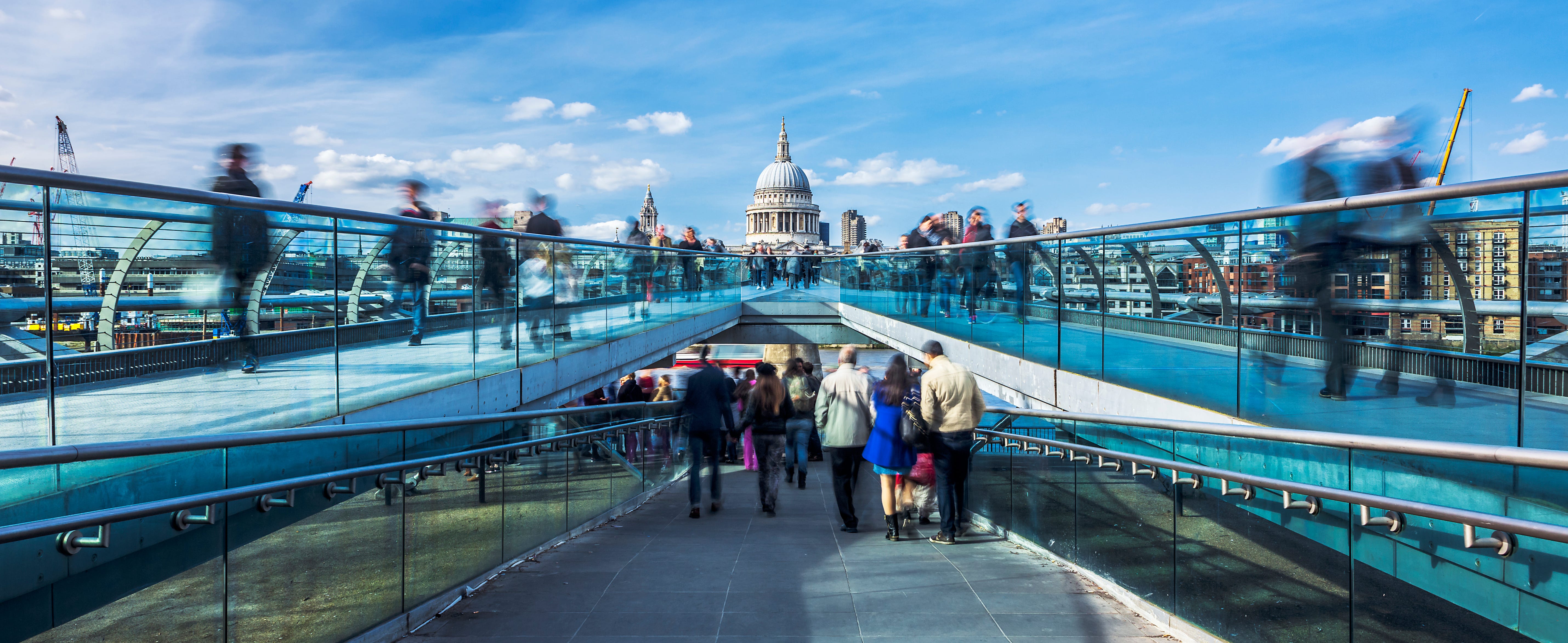
We become a field together.
You have watched a room synchronize before anyone gave the signal.
No one calls for alignment.
And still, something moves through the group.
Bodies read it.
Voices adjust to it.
Faces soften or close.
Ideas advance or disappear.
Risk expands or contracts.
The field forms.
And once it forms, everyone inside it begins responding to something they may not have chosen.
I have come to think this is one of the most underestimated facts about human beings.
Not that we are shaped by our environment — we have always known that. Something more unsettling. We do not simply live inside a field that someone else built. We *are* the field. We generate it, together, in real time, mostly without deciding to. And then we turn and respond to the very thing we just made.
So the question is almost never whether we synchronize.
We do. Always.
The question is what we are synchronizing to — and whether we ever chose it.
Begin with how automatic this is.
Sit across from someone and you will begin, without any intention, to mirror them. You match their posture. You pick up the rhythm of their speech. You uncross your arms a moment after they uncross theirs. If their mood drops, yours dips to meet it. Researchers call it the chameleon effect, and what is striking is not that it happens, but that it happens beneath awareness — and that it *bonds* us. The more two people unconsciously mirror each other, the more they tend to like one another. Synchrony is one of the oldest ways two nervous systems say: *I am with you.*
That is the beautiful face of it.
But the same wiring has another face.
In a now-famous set of experiments, people were asked to judge something utterly obvious — which of several lines matched a reference line. The task was not hard. But when everyone else in the room answered, with confidence, the same *wrong* way, a striking number of people went along with it. They set aside the evidence of their own eyes to stay with the group. Not because they were foolish. Because, in that moment, the pull to move with the others was stronger than the pull to be right alone.
That is the whole problem in a single experiment.
The instinct that lets us bond, attune, and move gracefully together is the same instinct that can quietly walk us off the edge of our own judgment. Synchronization is not good or bad. It is *powerful*, and it is *automatic*, and it does not ask where it is taking us.
There is a moment in recent history where you can watch this happen in steel.
On the tenth of June, 2000, London opened the Millennium Bridge — a sleek new footbridge across the Thames, aligned so that St. Paul’s rose perfectly at its far end. Tens of thousands streamed onto it that day, as many as two thousand on the span at once.
At first it was still.
Then it began, very slightly, to sway.
And here is the part that matters. As the bridge moved beneath them, the people on it did the most natural thing a body can do on an unsteady surface: they adjusted. They widened their stance. They shifted their weight to stay upright. And in doing so, almost none of them aware of it, they began to step in time — with the sway, and so with one another. Left, right, left, right, in something close to unison.
Those footfalls fed the motion. The larger sway pulled still more people into the same rhythm, which fed it further, which pulled in more. A loop. Engineers would later give it a tidy name — synchronous lateral excitation — for a strange and very human event: a crowd and a structure, together, producing a motion that not one person on that bridge had chosen or wanted.
They closed it within two days. It stayed closed for nearly two years while they fitted it with dampers to absorb what the crowd kept generating. Londoners, in the meantime, named it the Wobbly Bridge.
What moves me about it — and I will admit engineers are still arguing the precise mechanics two decades later, which is its own quiet lesson about how hard a field is to see even when it is shaking under your feet — is that no one was doing anything wrong. Each person was simply trying not to fall. Each individual adjustment was reasonable. And the sum of all those reasonable, unchosen adjustments became a force large enough to close a bridge.
We become a field together.
Sometimes the field is a swaying bridge.
And we should be careful not to call this a flaw.
It is part of how human beings have survived. We are social creatures. We are built to read the group, because for most of human history, the group was not optional. Belonging was protection. Exile was danger. So of course we learned to sense the field. Of course we learned to move with others. Of course we learned to adapt.
But adaptation does not always ask whether the thing we are adapting to is healthy.
This is why I keep thinking about Jane Goodall.
Not only because of what she discovered, but because of how she discovered it. Goodall did not begin by standing above the living world and reducing it into categories. She watched. She waited. She learned the individuals. She gave them names, which was considered unscientific by some at the time. She noticed patterns over time. She gave herself enough proximity to see what distance would have missed.
And because she watched differently, she saw differently.
The chimpanzees were not the simple creatures science had imagined. They made and used tools. They hunted. They formed bonds. They played. They cared for their young. They showed preference, personality, intelligence, memory, relationship.
They were not less scientifically knowable because they were seen as individuals.
They became more scientifically knowable because they were seen in context.
But Goodall’s work also matters because it did not romanticize life. At first, what many of us want to see in nature is harmony. Kinship. Intelligence. Tenderness. And all of that is real. But it is not the whole truth. Over time, Goodall and the researchers at Gombe also observed aggression, dominance, territorial conflict, and brutality. The same living community that revealed care also revealed danger.
That is not a reason to become cynical. It is a reason to become more truthful.
Because the question was never whether living beings are good or bad. The question is what a social field is organizing them toward. When the social ecology changes — when hierarchy hardens, when belonging narrows, when rivalry intensifies, when threat stories spread, when “us” and “them” become more real than shared life — behavior changes with it.
We learn the room. We learn who matters. We learn whose pain counts. We learn what can be ignored. We learn what earns protection. We learn what kind of behavior keeps us close to belonging, status, safety, affection, or power.
And if we are not awake, we may begin to move with a field we never consciously chose.
Which brings me back to the birds.
It is like watching a flock turn in the sky. Each bird has its own body, its own nervous system, its own capacity for motion. But when the flock turns all at once, we understand that something more than individual preference is happening. There is a field. There is a signal. There is a shared responsiveness to conditions the single bird does not fully explain.
And I want to be careful here, because synchronization is not always a problem.
Sometimes it is beautiful.
A flock of birds turning together in the sky can be mesmerizing. The beauty is not that every bird disappears into the flock. The beauty is that each bird remains alive, responsive, sensing, adjusting — and still, somehow, the whole becomes more graceful than any one body could be alone.
That is what healthy culture can do. It can create coherence without erasing difference. It can help people move together without making them the same. It can hold a shared rhythm while still leaving room for thousands of distinct forms of aliveness inside it.
But that is not the only kind of synchronization.
There is another kind — quieter, more costly — where people begin to match the room because the room has trained them to. They stop saying the risky thing. They over-prepare before speaking. They wait to be invited. They perform confidence instead of feeling belonging. They become fluent in the signals of the environment, and over time the adaptation starts to look like personality.
A flock is not beautiful because every bird becomes the same. It is beautiful because each bird remains fully alive while participating in a larger movement.
That is what the best cultures do. They do not erase the individual. They make a wiser collective possible.
But notice what the bird has that we so often do not: it is *awake* inside the turn. It feels the field and stays itself within it.
We synchronize before we choose. That is our wiring, and it is not going away. The bridge will always sway a little. The room will always move through us. The only question that stays ours is the one we began with — what are we synchronizing to, and did we ever choose it?
To answer that, we first have to be able to see the field at all. And the field reaches us most powerfully not through systems, or structures, or anything we could put on an org chart.
It reaches us through each other.
But that is the next turn.