
Emotional Architecture 101
A Systemic Way to Understand the Living Structure Beneath Behavior

They assign traits.
They rank tendencies.
They summarize behavior.
But descriptions are not explanations.
They tell us what we tend to do—but not why, and not why it changes under pressure, care, or uncertainty.
At The Language of Being™, we start from a different premise:
You are not a type.
You are not static.
You are a living system.
And your behavior emerges from the interaction of multiple emotional dimensions—not from a single label.
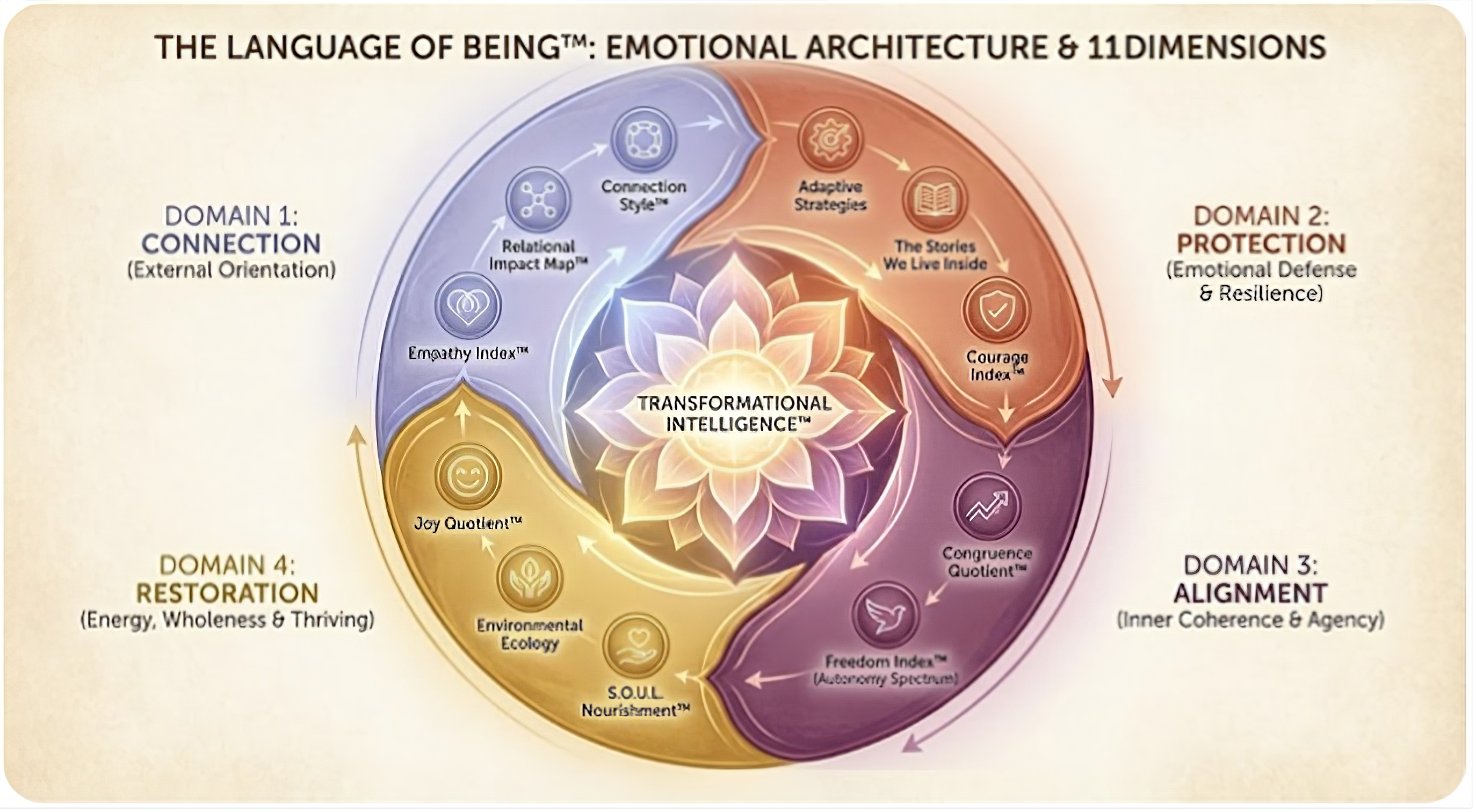
This is what we mean by Emotional Architecture.
What Is Emotional Architecture?
Emotional Architecture is the underlying structure that shapes how you:
connect with others
protect yourself under stress
restore your internal resources
and grow beyond outdated patterns
It is not personality.
It is not pathology.
And it is not fixed.
It is the invisible framework beneath reactions, relationships, and results.
No single dimension tells the whole story.
What matters is how they interlock.
Dimension One: Connection
How You Reach
Connection describes how you instinctively move toward people, ideas, and opportunities.
It reflects patterns such as:
initiating vs. responding
leading with energy vs. restraint
offering vulnerability first vs. competence first
Your Connection Style formed early, shaped by the emotional ecosystem you grew up in. It was your system’s best answer to a foundational question:
“How do I belong here?”
Connection is patterned, but not permanent.
Under safety, it often expands.
Under threat, it may narrow or intensify.
Dimension Two: Adaptive Strategies
How You Protect
When connection feels threatened, another layer activates.
Adaptive Strategies are the emotional and behavioral responses you engineered to stay safe when the environment demanded it.
They are not flaws.
They are not dysfunction.
They are adaptive brilliance.
Perfectionism.
Withdrawal.
Hyper-vigilance.
Control.
Self-reliance.
These strategies once solved real problems.
Here is the critical insight:
Two people with the same Connection Style can have completely different Adaptive Strategies.
This explains why people who seem emotionally similar on the surface can behave very differently under stress, conflict, or uncertainty.
Dimension Three: S.O.U.L. Nourishment™
How You Restore
Every system requires fuel.
S.O.U.L. Nourishment™ is not a spiritual or religious construct.
It is an alliterative framework that describes a pathway to inner congruence and sustainable functioning:
S — Self-honoring: recognizing and respecting internal truth
O — Ownership: taking responsibility for patterns and choices
U — Unburdening: releasing narratives and strategies that no longer serve
L — Living practice: embodying new emotional states through action
When nourishment is sufficient, your system has flexibility.
When it is depleted, even minor stressors feel overwhelming.
Many behaviors we try to “fix” are actually symptoms of under-nourishment, not character.
Where Inner Agility Comes From
Inner Agility is not a dimension.
It is an emergent capability.
It arises when:
your Connection patterns are understood
your Adaptive Strategies are conscious
your S.O.U.L. Nourishment™ is intact
Inner Agility is the capacity to respond rather than react.
To remain present across difference.
To choose among multiple strategies instead of defaulting to one.
It is not something you possess.
It is something you cultivate.
Why This System Matters
Most models isolate behavior.
Emotional Architecture explains behavior in motion.
It helps us understand why:
we thrive in some environments and struggle in others
insight alone hasn’t produced change
growth feels exhausting instead of liberating
Because awareness without architecture leaves people informed—but not free.
The Shift That Becomes Possible
When people see their architecture clearly, something subtle but profound happens.
Shame dissolves.
Curiosity replaces judgment.
Choice expands.
They stop asking:
“What’s wrong with me?”
And start asking:
“What is my system responding to—and what does it need now?”
That question restores agency.
And agency—not force—is what makes transformation sustainable.
Coming Soon:
How Emotional Architecture Shapes Culture
Why teams, organizations, and institutions behave the way they do—and how small shifts in relational architecture can change everything.